
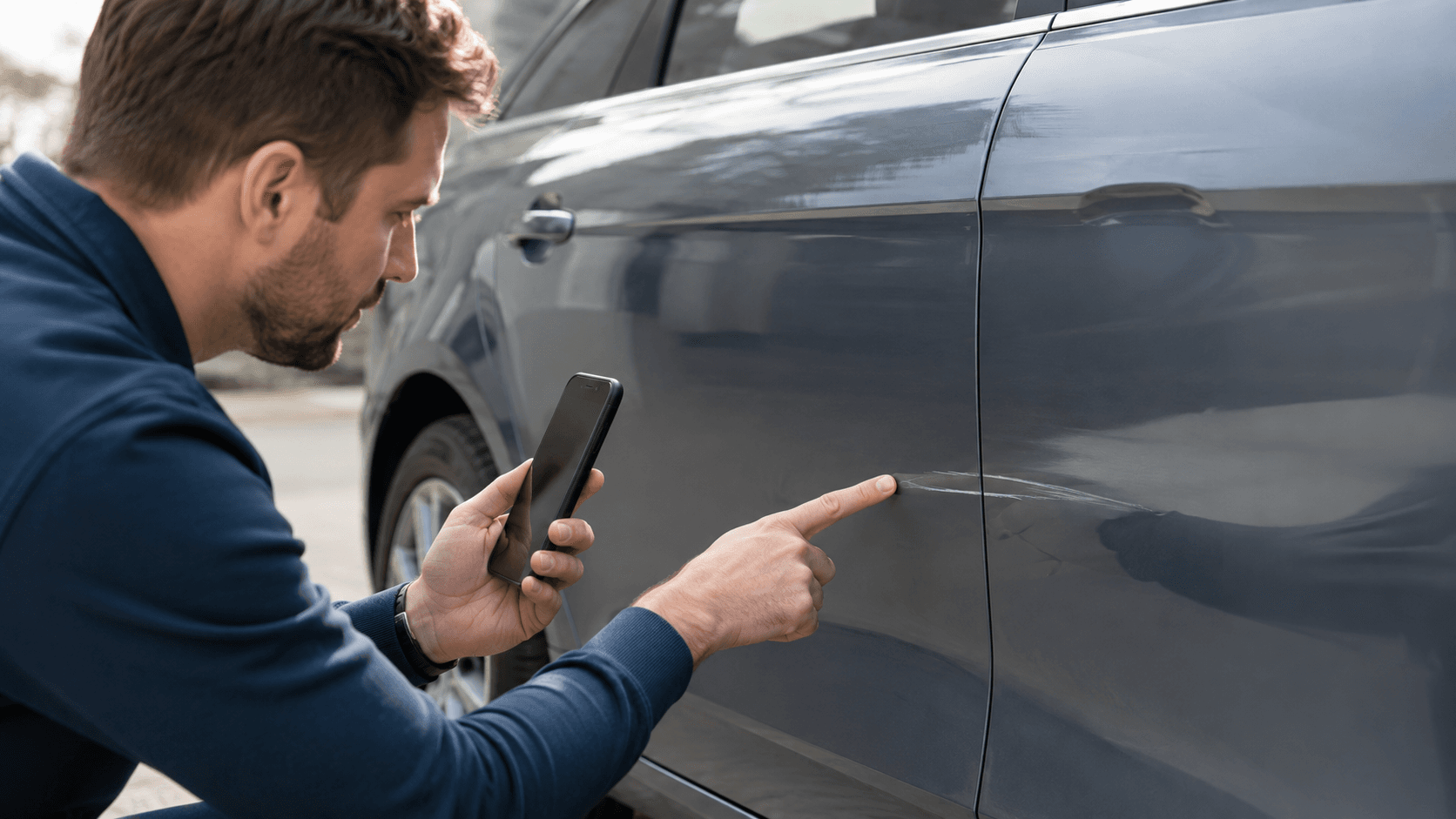
Can a Car Scratch Be Repaired Without Repainting?
Not every car scratch requires repainting. Learn when a scratch may be limited to the clear coat, when touch-up or spot repair may work, and when repainting is actually necessary.
Quick Answer
Yes, some car scratches can be repaired without repainting the affected panel.
If the scratch is limited to the clear coat or involves material transferred onto the surface, the original paint may still be intact. Deeper scratches that cut into or through the vehicle's color coat are more likely to require touch-up paint, spot paint repair, or refinishing.
The biggest factor is not how noticeable the scratch looks. It is how deeply the damage extends into the vehicle's finish.
Why Some Scratches Need Paint and Others Don't
A vehicle's painted finish is made up of multiple layers.
At a basic level, those include:
- The surface underneath the paint
- Primer
- The vehicle's color coat
- A protective clear coat
A scratch does not necessarily penetrate through all of them.
Some scratches only affect the clear coat at the surface. Others cut into the colored paint. More severe scratches can expose primer or the material underneath.
That difference determines whether repainting is necessary.
How Deep Is the Scratch?
One of the most useful ways to think about a scratch is by the layer it appears to affect.
Clear-Coat Scratches
A clear-coat scratch affects the transparent protective layer over the vehicle's paint.
These scratches may appear as:
- Fine lines
- Light surface marks
- Swirl-like scratches
- Scratches where the original paint color remains visible underneath
Because the colored paint may still be intact, repainting is not always necessary.
Depending on the depth and condition of the clear coat, the scratch may be addressed without applying new color.
Scratches Into the Paint
Once a scratch passes through the clear coat and reaches the vehicle's color layer, the repair becomes more involved.
You may notice:
- A stronger contrast inside the scratch
- Missing color along part of the damaged area
- A scratch that remains clearly visible from multiple angles
- A different layer showing underneath
At this point, some form of paint repair may be needed.
The repair can still vary considerably depending on the size and location of the damage.
Scratches Through the Paint
A deeper scratch can penetrate through the color coat and expose the primer or surface underneath.
These scratches generally require paint to properly restore the damaged area.
Possible repairs can include:
- Touch-up paint
- Spot paint repair
- Small-area refinishing
- Full-panel repainting
The appropriate option depends on how much of the finish has been damaged.
Could It Be Paint Transfer Instead of a Scratch?
Sometimes what looks like a serious scratch is partly material sitting on top of your vehicle's paint.
Paint transfer commonly occurs when the vehicle rubs against another painted object.
You might see:
- A different color across the surface
- A large-looking scrape
- Marks that appear worse than the surrounding damage
- Surface material along the affected area
If the vehicle's original paint underneath remains intact, some or all of the transferred material may be removable without repainting.
There can still be an actual scratch underneath, so removing the transfer does not always mean no additional repair is needed.
This is why determining what you are actually looking at matters before assuming the vehicle needs new paint.
When Can a Scratch Be Repaired Without Repainting?
A scratch is more likely to avoid repainting when the damage is limited to the surface.
Examples may include:
- Light clear-coat scratches
- Minor surface scuffs
- Paint transfer with intact paint underneath
- Very shallow scratches
- Marks that have not penetrated the color coat
However, appearance alone does not always reveal the full depth of the damage.
A thin scratch can still be deep, while a large-looking scuff may barely affect the underlying paint.
When Is Touch-Up Paint Enough?
Touch-up paint may make sense when the scratch is small but has removed some of the vehicle's original paint.
It is commonly used for:
- Small isolated scratches
- Paint chips
- Tiny areas of exposed primer
- Minor areas of missing color
Touch-up paint is different from refinishing a larger section.
It is generally intended to address a small defect rather than recreate the same finish produced by repainting and blending a broader area.
That makes it useful for certain minor repairs, but not every scratch is a good candidate.
When Does a Scratch Need Spot Paint Repair?
Spot paint repair may be appropriate when a scratch is too significant for a basic touch-up but does not necessarily justify repainting an entire panel.
It can be considered when:
- The scratch has penetrated the color coat
- The damaged area remains relatively contained
- More than a tiny amount of paint is missing
- A more complete cosmetic repair is desired
- The damaged area can be effectively refinished and blended
During a spot repair, the affected section is prepared, painted, and blended into the surrounding finish.
Whether this works well depends on the vehicle, paint color, location of the scratch, size of the damage, and surrounding finish.
When Does the Entire Panel Need to Be Repainted?
Sometimes repainting the full panel provides the more appropriate repair.
This may happen when:
- The scratch extends across a large part of the panel
- Several scratches affect the same area
- The damage is deep and extensive
- A smaller repair would be difficult to blend
- The surrounding paint is already deteriorated
- There is other paint damage on the same panel
A full-panel repaint is not automatically required because a scratch is deep.
The overall size, location, finish, and expected result all matter.
What About Key Scratches?
Key scratches can be particularly difficult because they are often long and narrow.
Although the damaged area may not be wide, the scratch can extend across a substantial portion of a door, fender, quarter panel, or multiple panels.
The repair depends on how deeply the scratch penetrated.
A lighter key scratch may primarily affect the clear coat.
A deeper one may require:
- Preparing the damaged area
- Restoring the affected paint layers
- Matching the vehicle's color
- Blending the new finish
- Restoring the protective clear coat
The length of the scratch can also make a targeted repair less practical than it would be for a smaller defect.
Why You Should Identify the Scratch Before Choosing a Repair
The word "scratch" describes what the damage looks like, not necessarily what repair it needs.
Two scratches of similar length may require completely different work.
One may only involve the clear coat.
Another may cut through the color coat.
Another may expose the material underneath.
That affects:
- The repair method
- How much of the vehicle needs to be refinished
- The expected result
- How long the repair may take
- What the repair should cost
If you are unsure what level of repair your vehicle needs, VHQL can help you start with the damage itself rather than guessing which paint repair service to search for.
How VHQL Helps You Understand Your Scratch
Most vehicle owners do not want to guess whether a scratch needs touch-up paint, spot repair, or a full repaint.
They want to understand what they are looking at before choosing where to take the vehicle.
VHQL is designed to make that first step easier.
With a guided vehicle scan, VHQL analyzes visible damage and helps organize information around:
- The affected area
- Damage type
- Damage severity
- Appropriate repair path
- Estimated repair cost
Instead of starting with a broad search for paint repair and trying to describe the damage yourself, you can start with the condition of your actual vehicle.
From there, the business can review the request and confirm the final price before any work begins, giving you more clarity from the start.
If you already have paint damage you want to understand, you can start with VHQL before deciding which repair or business is right for your vehicle.
Start With the Scratch
Before assuming your vehicle needs to be repainted:
- Look at where the scratch is located.
- Determine how large the affected area is.
- Understand how deeply the scratch appears to extend.
- Identify whether you are seeing missing paint, surface damage, or paint transfer.
- Match the repair to the actual damage.
A scratch does not automatically mean a repaint.
The right repair starts with knowing what the scratch actually damaged.
Frequently Asked Questions
Can a car scratch be fixed without repainting?
Yes. Some scratches affect only the clear coat or surface of the vehicle and may not require new paint. Deeper scratches that penetrate the color coat are more likely to require paint repair.
How do I know if a scratch went through the paint?
A deeper scratch may show a different color or material underneath the vehicle's exterior paint. Missing color within the scratch can also indicate that it has penetrated beyond the clear coat.
Does a deep scratch always require a full-panel repaint?
No. Some deeper scratches can be addressed with touch-up paint or spot paint repair. The size, location, depth, paint color, and surrounding finish determine whether a full-panel repaint is necessary.
Can paint transfer look like a deep scratch?
Yes. Material from another object can make a scrape appear more severe than the damage underneath. Once the transferred material is removed, the actual condition of the vehicle's paint can be evaluated more clearly.
Can touch-up paint repair a car scratch?
Touch-up paint can work for certain small scratches where paint is missing. Larger, longer, or more visible scratches may require a more complete refinishing process.
What is the difference between a clear-coat scratch and a paint scratch?
A clear-coat scratch affects the transparent protective layer above the vehicle's color. A paint scratch penetrates deeper and damages the colored paint itself.
When should a scratched car panel be repainted?
Repainting may be appropriate when the scratch is extensive, affects a large portion of the panel, is difficult to blend with a smaller repair, or is accompanied by additional paint damage.
Can VHQL help identify what kind of scratch my car has?
VHQL uses a guided scan to analyze visible vehicle damage and help identify the affected area, damage type, severity, appropriate repair path, and estimated cost. The business performing the repair can then review the request and confirm the final price.